
Business

Beside an employment contract, you will need various employment documents to cover the various aspects of employment in Hungary. The required documents will depend on your field of operation, on typical working hours, on benefits you provide, and several other factors. Work with an HR compliance expert like Helpers to create appropriate documents – and avoid spending time and money on documents you don’t need.
The post What employment documents does your company need in Hungary? appeared first on Helpers Hungary.

Every Hungarian company needs an accountant to take care of reporting obligations right from Day 1, even if the company sits idle for a while after registration. This is why it makes sense to do business setup with a provider that also offers accountancy – like Helpers. Let us help you with the full range of tasks related to business operation in Hungary!
The post Business setup and accountancy in Hungary appeared first on Helpers Finance.

What to do when your Hungarian business operation has reached its end? You can sell your company if you find the right buyer, but normally, it is best to liquidate it. If it has no issues, that can simply be done by your accountant, although it takes some time. You could also simply abandon it, but that poses several risks.
The post How to finish your business operation in Hungary – All about liquidation appeared first on Company Formation.

When you make a written agreement about anything, it should comply with certain formal requirements to make it a binding document. You are expected to put your signature and initials in specific places, provide appropriate attestation, and use a blue ink pen.
The post Formal requirements of a contract in Hungary appeared first on Helpers Hungary.

When you make a written agreement about anything, it should cover certain topics to ensure that both parties are aware of their rights and obligations. If there is a dispute in the future, it can be settled based on the terms laid out in the contract and in the relevant law.
The post What to include in a contract in Hungary? appeared first on Helpers Hungary.
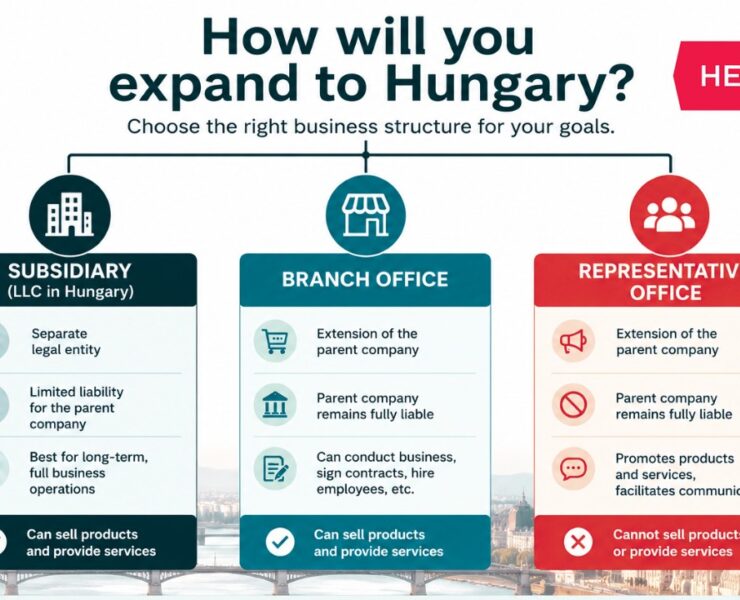
If you already operate a business abroad and are planning to expand into Hungary, you have several options available. The most common solution is to establish a Hungarian limited liability company (LLC), but depending on your goals, a branch office or a commercial representative office may also be worth considering.
The post Subsidiary, branch office, representative office in Hungary – which one is right for your business? appeared first on Company Formation.

With TISZA Party winning the last elections, Hungary is ready to strengthen ties with the EU, which will include working more closely with EU institutions, and which puts the introduction of EUR in the not-too-distant future. Markets have been reacting positively to the impending changes, making Hungary an even more attractive destination for business and investment.
The post Hungary to strengthen ties with the EU appeared first on Helpers Hungary.
If all goes well, a new business form will be available to European businesses from 2027: EU INC. It will be possible to set up an EU INC in either of the 27 member states of the EU, but the company will be able to operate legally in all of the member states. For now, this is just a plan – stay tuned for updates.
The post EU INC and Hungarian company formation appeared first on Company Formation.

On April 12, TISZA party garnered a landslide victory in the latest general elections in Hungary. With that, the FIDESZ government will be replaced after their 16-year rule. Foreign exchange rates and stock markets seem hopeful about the results and the increased stability a TISZA government promises. At the same time, immigration related rules are not expected to change in the immediate future.
The post Election results in Hungary – what to expect from a TISZA government? appeared first on Helpers Hungary.

The European Commission is working hard to make the EU more competitive in the global market. As part of this effort, they have introduced the concept of the 28th regime, a virtual state besides the existing 27 member states. Through this, EU businesses could easily expand from their home country to the EU market by setting up an EU Inc. business.
The post What do EU Inc. and the 28th regime mean for business in the EU? appeared first on Helpers Hungary.