Pentecost in Hungary
About Whit Sunday in a nutshell
Whit Sunday is the culmination of the Easter festivities that celebrate the death and resurrection of Jesus Christ, the central figure of Christianity and the incarnation of God. After he was resurrected on Easter Sunday, he walked the Earth and went to Heaven on the 40th day. Then, on the 50th day, as promised before, the Holy Spirit descended on his 12 apostles and Mary, mother of Jesus. The day coincides with a Jewish festivity, and the city of Jerusalem was full of people who came for the celebrations. When the apostles started to talk to them, the pilgrims all understood them as if they were speaking their own various mother tongues, which was considered the miracle of the Holy Spirit. Many who were there were baptized the same day, and this is how the Christian Church was founded.
The name of the day, Pentecost, comes from Greek and it means “fiftieth”, as it is the 50th day after easter (if you use inclusive calculation). The Hungarian word “Pünkösd” comes from the same word. In English, the day is also called Whit Sunday (or Whitsunday, or Whitsun) because of the white garment many people might wear at this time, including both newly baptized adults or children taking their first communion, which typically happen around this time.
Since Pentecost is tied to Easter, it is also a moving holiday. In Hungary, both Whit Sunday and Whit Monday are bank holidays. In 2026, they fall on May 24 and 25.
Christian celebrations
Since Pentecost commemorates the foundation of the first Christian Church, historically, Pentecost was the day many new converts would get baptized together. Children between 6 and 10 years would also take their First Communion either on Pentecost or during the weeks leading up to it. On the day of Pentecost, special masses are celebrated, and many churches organize indulgences – the most famous is the Csíksomlyó Pilgrimage in Transylvania, which attracts thousands of pilgrims every year and is considered a “Hungarikum”, a characteristic element of Hungarian culture. Otherwise, an indulgence is often a premise for getting together and celebrating with games, food, drink, and merchandise.
Pentecost folk traditions
There are various folk traditions tied to Pentecost. Most of them originate from the welcoming of the warmer seasons, renewal, and fertility, and as such, they involve singing, dancing, and flowers. Pentecost folk traditions vary a lot by area, so this is just a short overview of typical customs.
Maypole
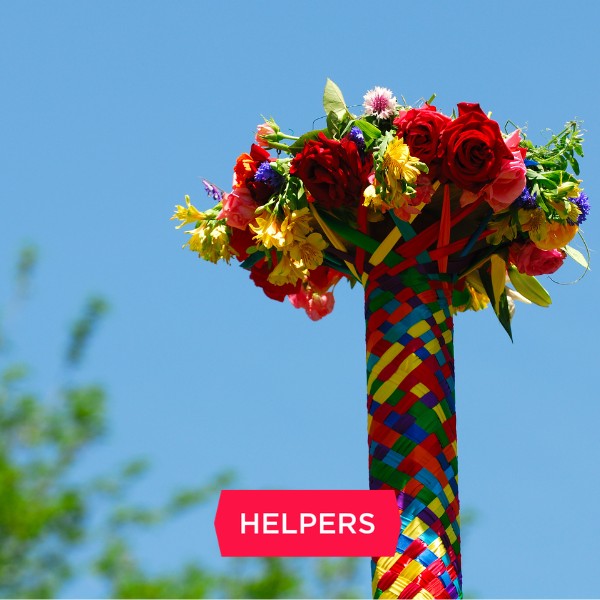
A maypole might be set up either the night before Pentecost or already on May Day. You will not necessarily see many of them in cities. Originally, they were set up in the main square of each village: imagine a tall column with a wreath on top of it, decorated with flowers, ribbons, and even food and drink. Depending on the area, young men would set up maypoles in the front yards of pretty girls, girls they courted, or even girls they were simply related to.
Choosing a Pentecost King
Through games and various contests, a Pentecost King is chosen from the unmarried young men – one of the contests can involve climbing the maypole. Entering the contests might also be considered a kind of initiation of young men. After the first time they participated, they would be allowed to go to the pub and to court women.
The Pentecost King would be considered a leader among the young men over the course of the next year, and he would be eligible for various benefits, such as being invited to every wedding or merrymaking, drinking for free at the local pub (financed by the community), or being exempt from penalties if his animals entered forbidden areas.
Since Pentecost Kings are elected only for the year, “Pentecost Kingdom” also means “a fleeting period of success” in Hungarian.
Choosing a Pentecost Queen
The Pentecost Queen is a young woman chosen not only for her beauty, but also for her diligence, piety, kindness, modesty, and virtue. The Pentecost Queen and her retinue of 4 other girls might go around the village singing, and stop in front of every house to bring good fortune there. They might get some kind of present in exchange.
Pentecost parade (“pünkösdölés”)
The Pentecost King and Queen and their retinue of young people and children would go around town singing, dancing, and collecting donations.
Putting out flowers
To adorn their houses, people would put green branches and flowers in their windows and on their fences. Typical flowers would include elderflowers, jasmines, and peonies (also called “Pentecost roses” in Hungarian).
Celebrate Pentecost like a Hungarian
Are you in Hungary during Pentecost? Then try and check out Pentecost-related events in your area, organized by local churches or town halls. If you have Hungarian roots, this might also be a great opportunity to learn more about the traditions in your family.
Based on your heritage, you might even qualify for Hungarian citizenship. In that case, we would be happy to help you on your journey. We have also built a free, online survey with which you can test if you have everything you need for the application.
FREQUENTLY ASKED QUESTIONS
Pentecost is the 7th Sunday or the 50th day after Easter Sunday (if you include that as the first day). Since it is tied to Easter, it is a moving holiday that falls on a different day every year, typically around the end of May or start of June.
In Hungarian, Pentecost is called “Pünkösd”. It comes from the same Greek root as Pentecost (πεντηκοστή, romanized: pentēkostē), which means “fiftieth”.
Yes, both Whit Sunday and Whit Monday are bank holidays in Hungary.
Did you like this article? Follow us on Facebook to learn more about Hungary, or subscribe to our monthly newsletter.
The post Pentecost in Hungary appeared first on Hungarian Citizenship.